The primary bottleneck in achieving most of our goals is thinking that being busy doing something means progress. Most professionals live in reactive compliance, constantly responding to notifications, emails, or chat pings, or the nearest deadline. This urgency addiction creates a false sense of accomplishment while creating no long-term value or progress towards goals. True productivity requires a shift from constant firefighting to deliberate action.
Workplace analytics show professionals waste up to 40% of their energy on low-value tasks simply because they look urgent. Learning to put first things first [Stephen Covey First Things First 1994 Original Source Document] is not a time-tracking trick; it is a well-proven decision-making framework. When we learn to separate a task’s immediate time pressure from its long-term value, we reclaim control over our daily schedule and protect our career trajectory from constant scope creep.
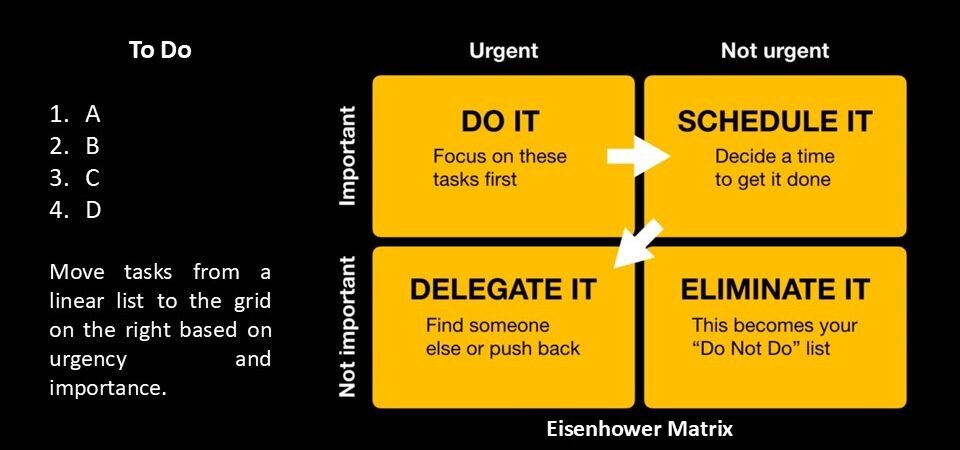
At the Corporate Skills Lab, we analyze personal effectiveness and efficiency through structured systems. By applying the Eisenhower matrix for prioritization to categorize our work, we eliminate confusion about what to do next. This framework transforms our daily to-do list from a source of constant anxiety into a predictable, high-yield plan.
The Lab Pillar Matrix
|
Pillar |
Focus |
Application |
Reason |
|
Immediate Action |
High urgency & high value |
Executing critical, time-sensitive projects on the spot. |
Protects the organization and team from immediate failure. |
|
Strategic Planning |
Low urgency & high value |
Scheduling dedicated blocks for execution and development. |
Guarantees long-term career growth and prevents future emergencies. |
|
Tactical Delegation |
High urgency & low value |
Transferring administrative tasks to alternative channels. |
Frees up bandwidth for high-impact work. |
|
Systemic Elimination |
Low urgency & low value |
Removing passive distractions and low-value habits. |
Eradicates distractions and protects daily focus. |
🔬 The Lab Report: The Eisenhower Matrix for Prioritization
- Quadrant 1: The Production Zone (Manage Immediate Crises)
The first quadrant handles tasks that are both urgent and important. These items represent immediate demands, client-facing emergencies, or project deadlines that require our expertise. We cannot avoid this quadrant entirely, but leaving it as is leads to stress and exhaustion.
- Lab Example: A server crash on a live client platform or a final budget approval due to the board by 5:00 PM. We must execute these items immediately. However, to stop this zone from expanding and consuming our entire week, we must take the next step to avoid such situations in the future. This brings us to the next zone.
- Quadrant 2: The Strategy Zone (Focus on Long-Term Value)
This quadrant houses tasks that are very important but do not carry an immediate deadline. This is the engine of professional development and true efficiency. Because these tasks lack an urgent buzzer, we tend to delay them to fight minor fires, which is a major mistake.
- Lab Example: Building a standardized team onboarding module, scheduling workout routines, or learning a new skill and getting a certification. To protect this space, we must carve out non-negotiable time on our calendars. Investing time here reduces the number of emergencies that pop up in Quadrant 1 later. [also read Strategic Time Management Frameworks]
- Quadrant 3: The Illusion Zone (Delegate Administrative Tasks)
Quadrant 3 consists of tasks that feel urgent because of real-time pings or social pressure, but deliver minimal long-term strategic value. This is the primary distraction and a driver of exhaustion without achieving anything. We often fall into the trap of spending hours answering minor instant messages instantly just to look active to our peers. Or end up spending a lot of time on unplanned catch-ups over coffee.
- Lab Example: Unstructured ad hoc meeting requests, generic status updates, or routine pings. We must handle these through alternatives like delegation, or learn to say NO when needed. [also read How to Say No]
- Quadrant 4: The Waste Zone (Eliminate Distractions)
The final quadrant holds activities that are neither urgent nor important. These are escape behaviors that we turn to when we experience cognitive overload from staying too long in the crisis zone, i.e., Quadrant 1. While brief relaxation is necessary, passive consumption does not lead to recovery.
- Lab Example: Sorting through excessive design layouts, doomscrolling news feeds or social media, or playing games. We must eliminate these habits from our active business hours. Removing this waste clears our cognitive runway, allowing us to finish our day cleanly and transition into true recovery time.
🧪 The Lab Report Summary: The Resource Filter
Mastering the Eisenhower Matrix for prioritization requires a continuous, conscious effort to push out of firefighting and into strategic execution. By managing crises, protecting our focus time, delegating non-important tasks, and eliminating distractions, we optimize our daily capacity. Before organizing tomorrow’s schedule, run every incoming request through this definitive filter: Is this task genuinely valuable to your goals, or is it simply loud? Protecting this boundary is the absolute key to steady, predictable career progression.
Also read: SMART Goal Setting


As an Amazon Associate, we earn from qualifying purchases at no extra cost to you.